2026
News list
-
AI-powered semantic mapping of the whole vocal repertoire in a cooperative bird society
Prof. Dr. Vittorio Baglione, Department of Biodiversity and Environmental Management, University of León
17.03.2026 10:00-11:30
Y42-K-80
-
Responses of mountain gorillas (Gorilla beringei beringei) to deceased infants
Drawing on 21 years of data from 141 infant deaths, this study shows that mountain gorilla mothers frequently carry deceased infants, with patterns shaped by infant age and cause of death. Findings highlight attachment bonds, caregiving roles and primate responses to death.
-
Not All Stress Is the Same: Variable Associations Between Psychosocial Stressors and Urinary Cortisol Rhythms in a Small-Scale Subsistence Society
Among Tsimane adults in Bolivia, different stressors—food insecurity, social conflict and economic problems—were linked to distinct daily cortisol patterns. Results reveal complex associations between stress, health and HPA-axis function in a subsistence society.
-

Book publication in German language
Thomas Geissmann & Helga Buchholz (2026). Die Mentawai-Sammlung Buchholz – Eine ethnographische Zeitreise. Gibbon Conservation Alliance, Institut für Evolutionäre Anthropologie, Universität Zürich, Zürich, 160 Seiten. ISBN: 978-3-033-11976-5
-

IEA in UZH News
Paola Cerrito in the latest issue of UZH Magazine (p.42 onwards) See the full issue here.
-

Evolutionary Roots of Conflict Insights from Primate Societies Symposium
Universität Zürich Hauptgebäude KOL G-217, 08:45
-
Bonobos innovate, plan, and transmit tool use to solve an extractive foraging task
The study investigates the individual, social, and environmental factors shaping tool use in sanctuary-living bonobos, finding that tool use is influenced by developmental factors, exposure to others using tools, and tool availability. The findings highlight the importance of social-learning opportunities and developmental biases in ape tool use, offering insight into conditions that may also have supported the emergence of tool use during hominin evolution.
-
Whole-Genome-Sequencing Reveals Demographic History and Patterns of Parallel Adaptive Evolution in Indo-Pacific Bottlenose Dolphins (Tursiops aduncus) Across Coastal Australian Seascapes
How do dolphins adapt to vastly different environments? A genomic study of bottlenose dolphins around Australia reveals parallel adaptation to tropical waters and uncovers how evolution, environment, and demographic history shape marine populations.
-
Identifying social learning through peering: predictions and recommendations
A new perspective article explores how “peering”, the sustained observation of conspecifics, can reveal social learning in animals. The proposed framework aims to strengthen research on culture, knowledge transmission, and cognitive evolution.
-
Model-based Metric 3D Shape and Motion Reconstruction of Wild Bottlenose Dolphins in Drone-Shot Videos
A new computer vision approach enables accurate 3D reconstruction of wild bottlenose dolphins from drone videos. The method captures both body shape and movement in natural settings, opening new possibilities for non-invasive wildlife research.
-
Dynamic vocal learning in adult marmoset monkeys
A new study reveals that adult marmosets learn from one another by continuously adapting their calls. This dynamic vocal learning helps maintain social bonds and may represent an important evolutionary precursor to human language.
-
Domestic goats can follow the direction of human voices to solve a hidden-object task
By following the direction of an unseen human voice, goats successfully located hidden food in a new study. The findings suggest that domestication may have fostered sophisticated communication skills between humans and animals.
-
Object manipulation scaffolds the development of tool use in children
From play to proficiency: Researchers found that young children develop tool-use skills through frequent object manipulation. Social learning opportunities and access to objects play a crucial role in this fundamental aspect of human development.
-

PhD Defense Nikhil Phaniraj
Convergence and Divergence: Forces Shaping Marmoset Vocal and Social Interactions
-
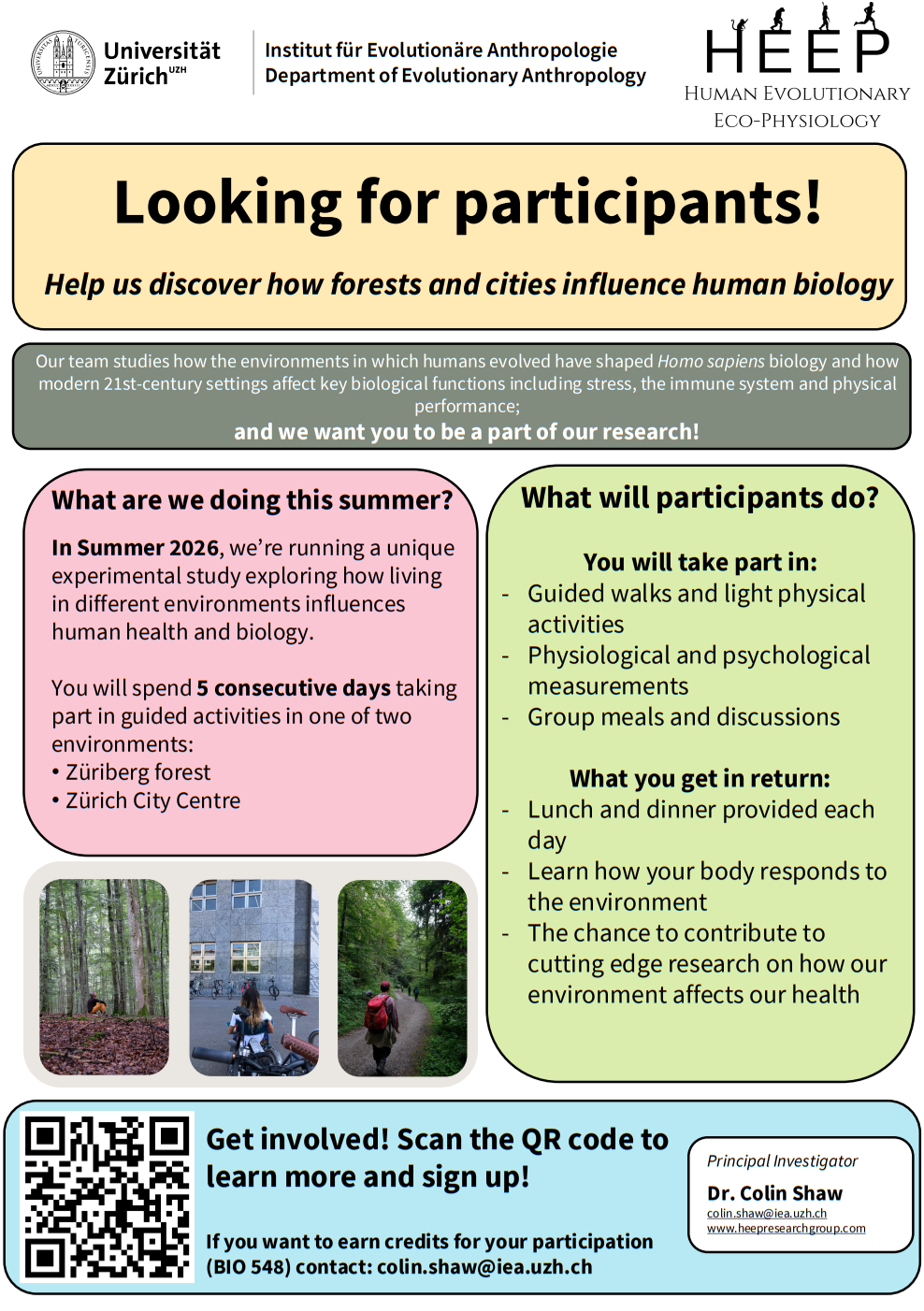
Looking for participants
Help us discover how forests and cities influence human biology
-

PhD Defense Viviani Mantovani Amador Cordon
Fine-Scale Genomic Diversity and Evolutionary History of Orangutans:
Maternal Persistence, Nuclear Differentiation and Population Vulnerability -

-

PhD Defence Svenja Marfurt
From Shallow Markers to Deep Genomes: Seascape Genomics of Indo-Pacific Bottlenose Dolphins (Tursiops aduncus) across Past, Present, and Future Oceans
-
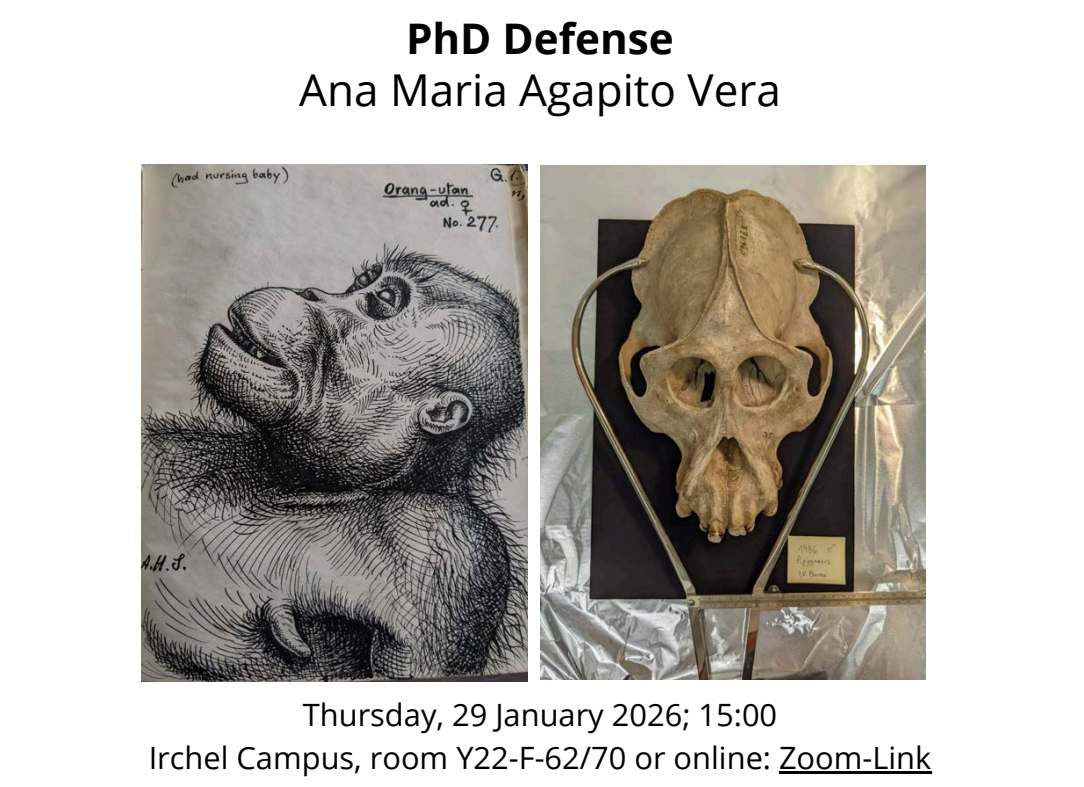
PhD Defense Ana Maria Agapito Vera
Population Genomics of Orangutans (genus: Pongo) Using Historical Specimens from Museums and Collections
-
UZH-Wide Media Success
The University of Zurich’s Top 10 Most-Read Research Stories of 2025 are out — and two of them come straight from our department!
#6 – Bonobo Call Combinations
#8 – Into the Woods with Colin Shaw
-
Culture is critical in driving orangutan diet development past individual potentials
Agent-based modelling of wild orangutan behaviour shows that social learning is essential for developing adult-like diet repertoires on time. Findings indicate that orangutan diets are culturally dependent and exceed individual learning limits.
-
Great Ape Childhoods: Social and Spatial Pathways to Independence in Bonobo and Chimpanzee Infants
Comparing wild bonobo and chimpanzee infants, this study finds similar developmental trajectories but distinct social and spatial patterns. Results show how species-specific social systems shape early independence and development in great apes.
-
Oxytocin varies across the life course in a sex-specific way in a human subsistence population
Using the largest oxytocin dataset to date from the Tsimane of Bolivia, this study shows sex-specific, nonlinear changes across the life course, linking oxytocin to reproduction, caregiving and health under conditions of energetic constraint.
-
Higher-order interactions shape collective human behaviour
This paper shows how higher-order social network models capture group interactions beyond pairwise ties. Using empirical data, it reveals mechanisms of cooperation, contagion and moral behaviour invisible in traditional dyadic network approaches.